Uncategorized

What Gloria Steinem Taught a Gay Kid from Louisiana

The news of Gloria Steinem’s death gave me pause today. Not simply because she was an extraordinary writer, journalist, organizer, and one of the most recognizable voices of the modern feminist movement, but because her death made me think about a much younger version of myself sitting in classrooms at LSU in the early 1990s, taking courses in Women’s and Gender Studies and encountering her writing for the first time.

I was a young gay man in Louisiana who was still figuring out exactly who I was, what I believed, and how much of what I had been taught about the world deserved to be questioned. Suddenly, here were writers asking me to question nearly all of it. Who gets power? Who gets heard? Whose experience is treated as the “normal” experience? Who gets represented, and who gets erased? Who made the rules in the first place? And perhaps most importantly, just because something has always been a certain way, why should we assume it has to stay that way?

Steinem was one of the people who taught me to ask those questions. Her feminism was rooted in equality and human dignity, but those ideas traveled far beyond gender for me. Once you begin examining one hierarchy, it becomes awfully difficult not to notice the others.

As a gay man, I found enormous freedom in feminist thought. It gave me language for things I had experienced long before I knew how to name them: gender expectations, masculinity, conformity, power, visibility, and the policing of people who dared to step outside the identities society had assigned them. It helped me understand that homophobia and sexism were not strangers to one another. They were relatives, both dependent in part on enforcing very narrow ideas about what men and women were supposed to be, how they should behave, whom they should love, what families should look like, and what masculinity and femininity were allowed to mean.

I probably could not have articulated all of that at 19 or 20. I was simply absorbing it. Those ideas were finding their way into the person I was becoming, and they stayed with me long after I left LSU.

Almost three decades into my career as an educator, I can see their influence there too. I don’t mean that I walk into a French classroom and lecture fifth graders about second-wave feminism. I mean something much more fundamental. I notice who speaks and who doesn’t. I wonder whose voice is missing. I question materials that present one kind of family, one culture, one childhood, or one type of person as the default. I think about the student sitting quietly in the room who has not yet found the words for who they are.

I think about representation, but even more, I think about belonging. Is the classroom I have created asking children to conform to it, or is there enough room inside it for them to become themselves?

Over the years I have also become increasingly skeptical of education built primarily around compliance: sit here, do this, learn this, don’t question that. There is something profoundly important about asking a child, “What do you think?” There is something deeply democratic about teaching young people that authority can be questioned, that perspectives matter, and that their experiences belong in the conversation.

That philosophy also influences the way I teach language. A language classroom can very easily become a parade of vocabulary lists, conjugations, flags, food, and tidy little cultural facts. But language is about people. It is about identity. It is about how human beings see themselves and how they understand one another. When we teach another language, we have an opportunity to show students that the world is larger than their own experience and that there is rarely only one “normal” way to live a life.

That lesson matters to me enormously.

Perhaps part of the reason is that I remember what it felt like to be a young gay man trying to locate himself within a culture that did not always leave much room for him. Reading feminist thinkers gave me permission to examine the structures around me instead of assuming that I was the one who needed to fit more neatly inside them. That distinction changed a great deal for me.

It also changed the way I eventually came to see my responsibility as a teacher. My job is obviously to teach French, but after all these years I know that no teacher teaches only a subject. We teach students how to participate in a community. We teach them, intentionally or unintentionally, whose voices matter. We communicate what kinds of difference are welcomed and what kinds are merely tolerated. We show them whether curiosity is rewarded or conformity is safer.

The funny thing about education is that sometimes you don’t recognize your teachers until decades later. Gloria Steinem was never my professor. I never met her. She certainly never knew that somewhere in Baton Rouge, Louisiana, a gay undergraduate was reading her work and quietly rearranging the furniture inside his head.

But she was one of my teachers nonetheless.

She helped teach me that inequality often hides inside things society has labeled “normal.” She helped me understand that liberation for one group cannot depend upon the oppression of another. She helped shape the way I think about gender, power, identity, and voice. Those ideas eventually followed me out of LSU, into my own classroom, and through nearly thirty years of teaching.

They shaped the way I understand myself as a gay man and the kind of educator I continue trying to become. They are there when I question whose story is absent from a lesson. They are there when I make room for a student who experiences the world differently. They are there when I remind children that learning another language is not simply about saying different words, but about discovering that there are other ways of seeing.

Perhaps that is one measure of a writer’s life. Not simply the books written, speeches delivered, organizations founded, or awards received, but the number of people who encountered an idea and carried it somewhere else.

Somewhere along the way, the young man reading Gloria Steinem at LSU became the teacher asking his own students to look at the world carefully, listen to people whose experiences differ from theirs, question assumptions, and make a little more room at the table.

I didn’t realize until today how much of that began in those classrooms.

So today, I find myself saying thank you, Gloria.

Your words traveled farther than you ever could have known.

Rest in peace, Ms. Steinem.

Uncategorized

REVIEW: Digital Delusion – or – I Can Hear the Drums Already – The Coming Ban on Student Tech

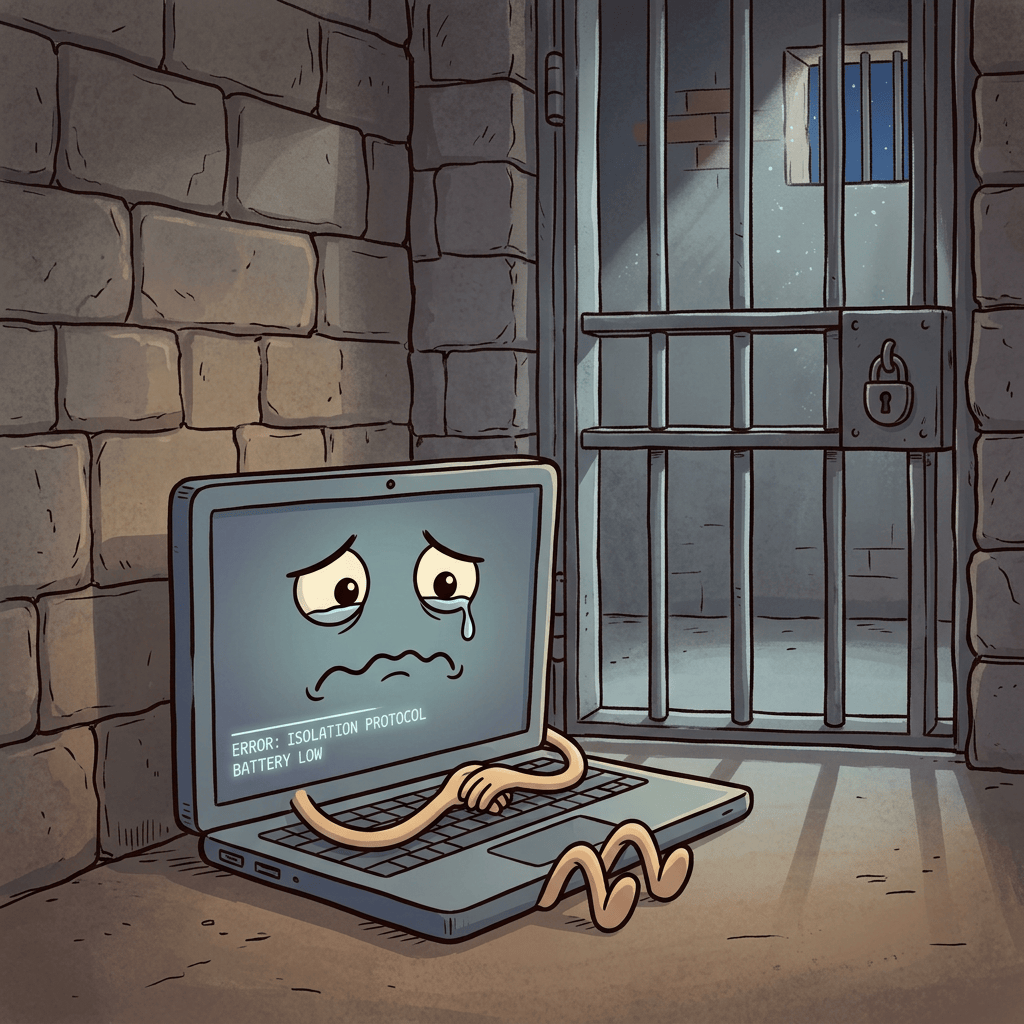
Crying laptop behind prison bars displaying “ERROR: ISOLATION PROTOCOL BATTERY LOW”
A crying laptop displays an isolation error while locked behind prison bars.

I am beginning to wonder if I have become the Cassandra of the education space, which is not exactly the niche I planned to occupy. In February 2020, I started saying that schools needed to prepare seriously for the possibility of remote teaching. The reaction ranged from skepticism to something closer to, “Have you lost your mind?” The idea that schools might close and that we might somehow have to teach children through computers from our homes seemed almost absurd.

Then March happened.

So when I say I can hear the drums again, I am paying attention. This time they sound like this: ban the phones, close the laptops, take away the iPads, bring back the books, back to paper, back to pencils, back to “real learning.” And after reading Jared Cooney Horvath’s The Digital Delusion: How Classroom Technology Harms Our Kids’ Learning—and How to Help Them Thrive Again, I understand why those drums are getting louder.

Horvath, a neuroscientist and educator, makes an aggressive case that schools have spent years embracing digital technology without asking a rather basic question first: does this actually help children learn? That question sounds obvious, but it really isn’t. For a long time, educational technology seemed to exist in a category of its own. New was assumed to be better. Interactive meant engaging. Personalized meant effective. Put an assignment on a Chromebook, add some animation and perhaps a digital badge, and suddenly we were innovating.

Horvath asks us to look underneath all of that. What is happening in the brain? What is happening to attention? What is being remembered? What cognitive work is the student actually doing? And perhaps most importantly, what did the technology replace?

That last question has stayed with me.

One of the ideas in The Digital Delusion that resonated most deeply with me is Horvath’s concern with the growing distance between completing a task and actually learning something. Technology is extraordinarily good at making things easier. That is usually why we invent it. But learning is strange. Easier is not always better. Sometimes the struggle is the point.

I see this constantly as a language teacher. Ask a fifth grader to write three sentences in French about what they like to do and, without digital assistance, you may get something like: J’aime jouer au soccer. J’aime les jeux vidéo. J’aime… Then comes the pause. The student stares at the ceiling. “Wait. I know this.” They look toward the word wall. Maybe they gesture swimming at me. Maybe they ask another student. Maybe they make an imperfect guess. Finally: J’aime nager.

That ten-second struggle can look like inefficiency. We have designed an entire technological ecosystem capable of eliminating it. Type the English into a translator. Accept the predictive text. Ask AI. Done. Except something important may have disappeared during those ten seconds: retrieval. The child was searching memory, connecting meaning to language, testing possibilities and ultimately finding the word. That is not an obstacle standing in the way of learning. That is learning.

AI makes Horvath’s argument considerably more urgent because we now possess tools capable of eliminating not merely mechanical work but cognitive work. A student can produce a better paragraph, cleaner presentation, stronger translation or more sophisticated response while potentially doing less thinking than the student who produces something far messier. That creates an uncomfortable problem for teachers: the quality of the product is no longer reliable evidence of the quality of the learning.

Language teachers have been living with a primitive version of this problem for years. We know the student. We know roughly what that student can do in French or Spanish. Then a paragraph arrives containing sophisticated transitions, flawless adjective agreement and a verb tense we have never taught. Apparently three semesters of French happened over lunch.

We all know what happened.

Generative AI simply supercharges the problem. And Horvath’s book has pushed me to think harder about something I have probably known instinctively for years: I need to see my students thinking in the language, not merely see evidence that French eventually appeared on a page.

That means the messy parts matter more than I sometimes allow them to. The hesitation matters. The circumlocution matters. The mistake matters. The kid pointing at something because she cannot remember the word matters. The student saying Comment dit-on…? matters. The partner responding Je ne comprends pas matters.

In fact, Je ne comprends pas may be one of the most educationally productive sentences in my classroom, because now somebody has to do something. Try another word. Gesture. Point. Repeat. Slow down. Rephrase. Look at the other person’s face and determine whether the message landed. Real communication is full of friction, and real people do not come with drop-down menus.

This is where The Digital Delusion intersects powerfully with what good language teaching already tells us. Give two students different pieces of information and make them need each other, and suddenly language has a purpose. Tu as le chien? Non. J’ai le chat. Où est le chien? Je ne sais pas. Ask someone else. Point. Gesture. Forget a word. Check the word wall. Use the wrong word. Laugh. Fix it. Keep going.

There is nothing technologically impressive about this lesson. If someone walked past the classroom, they might see pieces of paper, picture cards, mini whiteboards and sixteen slightly chaotic conversations happening simultaneously. There is no glowing screen, no animation, no gamified leaderboard celebrating Antoine for earning 700 French Points. But cognitively, an enormous amount is happening. Students are listening, retrieving, interpreting, responding, watching facial expressions, adjusting their language, taking risks, discovering that the first attempt did not work and trying something else. They are communicating.

That matters more to me than whether the lesson would look impressive in a photograph about “21st-century learning.”

I found The Digital Delusion compelling, but I do not think every conclusion should be swallowed whole. Horvath makes a forceful case connecting the explosion of educational technology with deteriorating attention and academic performance, but some of the evidence he discusses is correlational, and correlation cannot by itself establish that school technology caused those declines. That distinction matters.

Children’s academic performance, attention and development are influenced by an enormous number of things. The pandemic happened. Social media exploded. Smartphones became ubiquitous. Childhood became more scheduled and less independent. Reading habits changed. Sleep changed. Family life changed. Schools changed. Technology is tangled up in that story, but untangling precisely how much each factor contributes is harder.

There is another place where I think the conversation requires more nuance: “technology” is an almost uselessly broad category. A child spending forty minutes clicking through a digital worksheet is using technology. A child in New Jersey listening to a teenager from Québec speak French is also using technology. Those are not remotely the same educational experience.

That distinction matters enormously to me because I do not want the Chromebook gone. Technology gives my students access to things I could not reproduce with cardstock and dry-erase markers. I can bring a street market in Senegal into my classroom. We can hear French spoken in Martinique, Québec, Belgium or Côte d’Ivoire. My students can watch young people their own age speaking naturally rather than constantly hearing French filtered through the voice of their American French teacher.

We can explore a museum in Paris, listen to music from Kinshasa, read an actual menu, watch an advertisement, hear different accents, and see that French is not confined to a textbook chapter called “La Francophonie” with some flags along the margin. Technology can make the language more human, and that is worth opening the Chromebook for.

So I do not finish The Digital Delusion wanting a bonfire in the faculty parking lot where we ceremonially toss our devices into the flames. I finish it wanting technology to earn its place in my classroom.

I have started using a fairly simple test: what becomes possible when I open this device that was not possible, or not nearly as effective, before I opened it? If the answer is that my students can hear authentic French from another part of the world, open it. If they can record themselves speaking and listen critically to their own pronunciation, open it. If they can communicate with another classroom, examine authentic media, collaborate with someone they otherwise could not reach, or access cultural material I cannot physically bring into the room, wonderful.

But if the answer is simply that they can type the worksheet instead of writing on it, I am increasingly unconvinced. If students are sitting three feet apart communicating through a shared document instead of speaking to one another, I have questions. If the technology exists primarily because the textbook company turned page 37 into something that now requires a password, I have even more questions. And if a student can push a button and outsource precisely the thinking that the assignment was designed to develop, I probably need to redesign the assignment.

That may be one of the biggest lessons I take from Horvath’s book. The question is not whether something is digital. The question is what happens cognitively when we use it.

There is one possible reaction to The Digital Delusion that worries me. Schools could read arguments like Horvath’s, collect the Chromebooks, print everything and declare the problem solved. That would be a spectacular missed opportunity. A bad worksheet does not become good pedagogy because I printed it. A packet is not rigorous because it is stapled. Copying vocabulary from a whiteboard into a notebook does not automatically become deep learning because a pencil was involved.

A room full of children silently completing fill-in-the-blank exercises on paper can be just as intellectually lifeless as a room full of children doing the same thing on screens. If the technological pendulum swings back, I hope we do not return to some imaginary golden age of education that never actually existed.

I want something better.

Give me the mini whiteboards, the picture cards scattered across the table, the maps and menus and manipulatives. Give me sticky notes and giant pieces of paper. Give me the kid who has forgotten the French word and draws it instead. Give me the student who stands up and walks across the room because she needs information from somebody else. Give me the partner who has absolutely no idea what his classmate just said and forces him to try again.

Give me sixteen conversations happening at once. Give me the ridiculous gestures. Give me the moment when half the class suddenly realizes they understood thirty seconds of French without translating it into English.

That classroom is not anti-technology. It is pro-human.

And that, more than anything else, is what I took from The Digital Delusion.

Horvath is very clear that his book is not intended as a rejection of technology. His larger argument is about reclaiming education as a human endeavor. That distinction is important, because I suspect the conversation surrounding his book will sometimes lose it.

The drums are getting louder. Phones are already disappearing from schools. Laptops and one-to-one device programs are facing greater scrutiny. Generative AI has accelerated questions we probably should have been asking long before ChatGPT arrived. I suspect a larger correction is coming.

Maybe Cassandra is talking again.

If so, I hope this time we listen carefully enough not to overcorrect. I do not want the future classroom to be defined by open laptops, and I do not want it defined by closed laptops either. I want it defined by what students are doing with their minds and with one another.

Sometimes the best tool for that will be a screen. Sometimes it will be a pencil. Sometimes it will be a book, a deck of cards, a map, a marker or a piece of paper with half the information deliberately missing.

And very often, especially in a language classroom, the most powerful learning technology will remain another human being sitting across the table saying:

Je ne comprends pas.

And waiting for you to figure out what to do next.

Uncategorized

My New Favorite School Supply

person holding giant magenetic notebook paper

I am apparently at the stage of my teaching career where giant magnetic notebook paper brings me an unreasonable amount of joy.

And I’m completely fine with that.

My newest school-supply obsession is this giant sheet of magnetic notebook paper that sticks right to the whiteboard. It looks exactly like the notebook paper my students use. . .blue lines, red margin, holes and all. ..except it is gloriously enormous. . .22 inches wide and 28 inches tall!

And I cannot wait to use it with my fourth-grade French students this year.

Actually, scratch that. I’m using it with my sixth graders, too.

Because there are few experiences quite as humbling as saying, “Open your French notebooks,” and then walking around the room and actually looking inside them.

Teachers, you know.

You open one notebook and everything is beautifully dated, titled, spaced and organized.

Then you open the next one.

The date is somewhere in the geographical center of the page.

Tuesday’s vocabulary is sharing real estate with something from three weeks ago.

One French word has been written in a space approximately 2 millimeters wide.

There are 17 completely blank lines followed by six sentences crammed into the bottom corner.

The margin has apparently been annexed.

Something is upside down.

And for reasons no one can adequately explain, there is a drawing of an eyeball.

Sometimes I look at a notebook and think:

WHAT HAPPENED HERE?

But here’s the thing.

Neat notebooks are a learned skill.

We sometimes treat organization as though children should simply know how to do it.

“Write the date at the top.”

“Put the title underneath.”

“Skip a line.”

“Start at the margin.”

“Number these.”

“Leave yourself some room.”

Those instructions make perfect sense to an adult who already has a mental picture of an organized notebook page.

A nine-year-old may not have that picture yet.

So instead of repeatedly telling my students what their notebooks should look like, this year I want to show them.

That’s where my ridiculous giant paper comes in.

When students open their notebooks, I can put the magnetic sheet on the board and create the exact same page in front of them.

21 août 2026 goes here.

Les animaux goes here.

We skip a line here.

Our vocabulary starts here.

This example belongs underneath.

This information goes together.

Leave this space because we’re coming back to it.

Suddenly, something abstract becomes concrete.

And I think this matters even more when we think about neurodivergence.

Taking notes sounds like one task.

It isn’t.

A student may simultaneously be trying to listen to me, process French, decide what information matters, remember what I just said, locate the correct place in a notebook, copy unfamiliar words accurately, keep pace with the class, organize information spatially on a page—and hopefully learn the French somewhere in the middle of all that.

That’s a lot.

For students who struggle with attention, working memory, planning or organization, simply saying “You need to keep your notebook neater” doesn’t necessarily teach them how to do that.

And frankly, plenty of neurotypical fourth graders need explicit modeling, too.

The more I teach, the more interested I am in making the invisible parts of school visible.

Don’t just tell a child to be organized.

Model organization.

Don’t just tell them where something goes.

Show them where it goes.

Don’t wait until their notebook has become an archaeological dig in November and then wonder why they didn’t understand our expectations.

Teach the expectation while we’re building the habit.

That’s what I’m hoping this absurdly large piece of notebook paper helps me do.

Will it magically transform every French notebook into a pristine work of art?

Absolutely not.

There will still be mystery doodles.

There will still be someone who writes the date halfway down the page despite the six-foot visual aid directly in front of them.

They are children. 😂

But if this helps make one more classroom routine explicit, reduces a little unnecessary cognitive load and gives students a visual model they can imitate until the routine becomes their own, I’m in.

Also…

IT’S GIANT MAGNETIC NOTEBOOK PAPER.

Look at it.

How was I supposed to not buy this?

💕 Nerding out over new school supplies! 💕

If you want to check out the giant magnetic notebook paper I bought, you can find it here:

Giant Magnetic Notebook Paper on Amazon

And now I need to know:

Teachers, what is your new favorite school supply this year?

Because apparently this is who we are now, and I would very much like to see what everyone else bought.

So. . .what is your favorite new school supply?

back to school, classroom, engagement, management, new teachers, Uncategorized

Making Every Minute Count

Cronometro

If you think about how little time we have with our students, you probably wonder how they ever meet all the learning objectives we’ve set for them. On a traditional schedule of 40 minutes a day, that equates to 200 minutes a week of instruction – or 120 hours a school year. Now subtract all the time taken away for assemblies, standardized testing, and absences – and you’ve got even less time. Now add up all the wasted time – transitions, sharpening pencils, bathroom breaks, and waiting for slower students to finish up tasks. Suddenly you’re faced with even less time to do all things it takes to get them speaking, listening, reading, and writing in their world language.

Never fear – there are some strategies to keep things moving along. With some judicious planning and consistency, you, too, can keep your class on track so that all your teaching objectives get attended to!

Supplies are a necessary tool for both you and your learners to use in order to get work done. Where do you store them? Are they easily accessible to students? Would having a stack of pre-sharpened pencils be helpful? Do your students know where to get blank writing paper? Make a place for these items and allow students access to it.

Target language use is really important. ACTFL, our national world language educators’ organization recommends that 90% of class be conducted in the TL. Many teachers chose to conduct portions of class in English because they believe it facilitates student understand. The problem with doing so is that it undermines the utility of the world language; you’re essentially showing the students that the target language isn’t important for communication. To increase student understanding, one merely needs to employ a series of Comprehensible Input strategies, such as adjusting teacher talk, using gestures and pictures, and giving examples. With these scaffolding interventions, students feel more supported and willing to open their receptivity to the target language. For other strategies, please consult Douglass Crouse’s “Going for 90% Plus: How to Stay in the Target Language.”

Directions and Routines are a part of every teacher’s classroom – whether her learners are in elementary school or high school. Those directions and routines will look a lot different depending on the age of the learner, but they are there for a purpose – to let students know what to do and how to do it. They keep order. Now doing this in the target language can complicate things, but if students are adequately prepared, then it can work. So make sure they know what you’re talking about – demonstrate, use visuals, do whatever it takes. Julie from Mundo de Pepita inspired me to make illustrated instruction cards so my learners always know what steps are necessary to complete a task. Read her blog entry here. The other important point to make about directions is this – if they’re too complicated for students to understand in the target language, then the task is too difficult for your students. Instead, do something they can do.

Do Now Activities/Bell Ringers are an excellent way to get students focused fast and eliminate the transition time into class. For a list of some tried and true bell ringers, please consult this Edutopia article and for world language specific bell ringers, try FLTeach Digest.

Filler activities are a great way to fill in spare time in class. A former mentor of mine once recommended to me to always plan for extra activities just in case you finish the regularly scheduled lesson faster than expected. This is especially important for teachers who teach on a block schedule.  For some quick time filler activities, try these from Education World.

Quick finishers are those students who sail through classwork and then need something to do when they’re done. I’m sure they’d rather listen to music, chat with friends, do homework for another class, or cram for next period’s test. Instead, they should be on task for your class. Over the years, I’ve tried different things depending on the age of the students and level of the class. I have a classroom library stocked with books and magazines in the target language. For teachers who want something a little more structured, you may have enrichment assignments or puzzles that pertain to the unit you’re currently working on.

Transitions can eat up a lot of your class time. My fabulous colleague, Señora Gragg, often bursts into song while passing out materials or collecting them. Her students join in and they make good use of an otherwise wasted moment. I love her effective use of time! She often has little kits waiting for her students – so that all the supplies needed for a certain activity are there and ready to go.

With this list of tips, I hope you can better fill your class time with meaningful activities that help lead your learners to higher levels of proficiency.

So, have you developed some strategies to maximize learning time in your classroom?

back to school, planning

Planning for Instruction

planning for instructionI was just talking with a colleague the other day about planning time – and I expressed how grateful I am for the time we get during the school day to do our planning. After all, good instruction can’t happen without good planning.

There are so many things to keep in mind as you are planning for your world language classes…

  • What are my students’ proficiency levels?
  • Am I getting my students to work in all three modes of communication: interpersonal, interpretive, and presentational?
  • Am I addressing a “big picture” item – like an Essential Question or an Enduring Understanding?
  • Am I building on what my students already know?
  • Am I properly preparing for the next thing they need to know how to do?

I hear a lot of teachers who get stressed out over planning and spend hours on honing the perfect lessons. That is certainly not a sustainable lifestyle. If you roughly map out your year, then your individual units, and then spend more time on your individual lessons, you’ll have a good framework to follow. With the manageable pieces identified, you’ll feel more comfortable with planning a few days to a week in advance on your lessons.

For a more step-by-step guide to planning for instruction, please check out my self-paced learning module: Planning for Instruction. Versal requires you to register, but it’s free!