
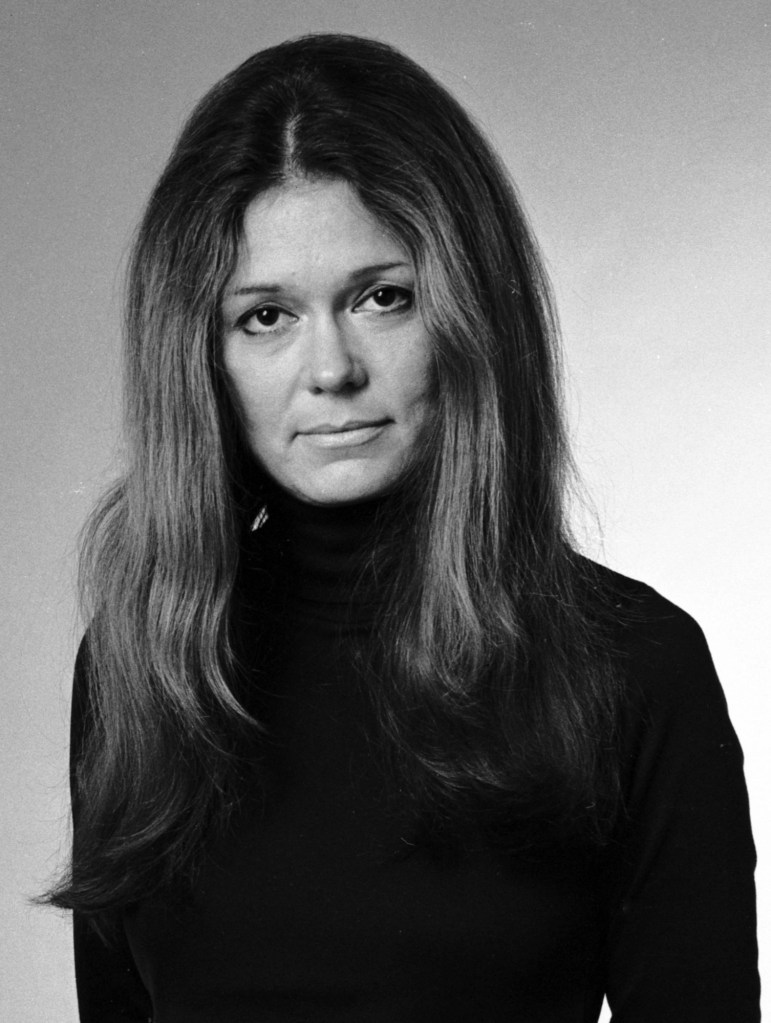
The news of Gloria Steinem’s death gave me pause today. Not simply because she was an extraordinary writer, journalist, organizer, and one of the most recognizable voices of the modern feminist movement, but because her death made me think about a much younger version of myself sitting in classrooms at LSU in the early 1990s, taking courses in Women’s and Gender Studies and encountering her writing for the first time.
I was a young gay man in Louisiana who was still figuring out exactly who I was, what I believed, and how much of what I had been taught about the world deserved to be questioned. Suddenly, here were writers asking me to question nearly all of it. Who gets power? Who gets heard? Whose experience is treated as the “normal” experience? Who gets represented, and who gets erased? Who made the rules in the first place? And perhaps most importantly, just because something has always been a certain way, why should we assume it has to stay that way?
Steinem was one of the people who taught me to ask those questions. Her feminism was rooted in equality and human dignity, but those ideas traveled far beyond gender for me. Once you begin examining one hierarchy, it becomes awfully difficult not to notice the others.
As a gay man, I found enormous freedom in feminist thought. It gave me language for things I had experienced long before I knew how to name them: gender expectations, masculinity, conformity, power, visibility, and the policing of people who dared to step outside the identities society had assigned them. It helped me understand that homophobia and sexism were not strangers to one another. They were relatives, both dependent in part on enforcing very narrow ideas about what men and women were supposed to be, how they should behave, whom they should love, what families should look like, and what masculinity and femininity were allowed to mean.
I probably could not have articulated all of that at 19 or 20. I was simply absorbing it. Those ideas were finding their way into the person I was becoming, and they stayed with me long after I left LSU.
Almost three decades into my career as an educator, I can see their influence there too. I don’t mean that I walk into a French classroom and lecture fifth graders about second-wave feminism. I mean something much more fundamental. I notice who speaks and who doesn’t. I wonder whose voice is missing. I question materials that present one kind of family, one culture, one childhood, or one type of person as the default. I think about the student sitting quietly in the room who has not yet found the words for who they are.
I think about representation, but even more, I think about belonging. Is the classroom I have created asking children to conform to it, or is there enough room inside it for them to become themselves?
Over the years I have also become increasingly skeptical of education built primarily around compliance: sit here, do this, learn this, don’t question that. There is something profoundly important about asking a child, “What do you think?” There is something deeply democratic about teaching young people that authority can be questioned, that perspectives matter, and that their experiences belong in the conversation.
That philosophy also influences the way I teach language. A language classroom can very easily become a parade of vocabulary lists, conjugations, flags, food, and tidy little cultural facts. But language is about people. It is about identity. It is about how human beings see themselves and how they understand one another. When we teach another language, we have an opportunity to show students that the world is larger than their own experience and that there is rarely only one “normal” way to live a life.
That lesson matters to me enormously.
Perhaps part of the reason is that I remember what it felt like to be a young gay man trying to locate himself within a culture that did not always leave much room for him. Reading feminist thinkers gave me permission to examine the structures around me instead of assuming that I was the one who needed to fit more neatly inside them. That distinction changed a great deal for me.
It also changed the way I eventually came to see my responsibility as a teacher. My job is obviously to teach French, but after all these years I know that no teacher teaches only a subject. We teach students how to participate in a community. We teach them, intentionally or unintentionally, whose voices matter. We communicate what kinds of difference are welcomed and what kinds are merely tolerated. We show them whether curiosity is rewarded or conformity is safer.
The funny thing about education is that sometimes you don’t recognize your teachers until decades later. Gloria Steinem was never my professor. I never met her. She certainly never knew that somewhere in Baton Rouge, Louisiana, a gay undergraduate was reading her work and quietly rearranging the furniture inside his head.
But she was one of my teachers nonetheless.
She helped teach me that inequality often hides inside things society has labeled “normal.” She helped me understand that liberation for one group cannot depend upon the oppression of another. She helped shape the way I think about gender, power, identity, and voice. Those ideas eventually followed me out of LSU, into my own classroom, and through nearly thirty years of teaching.
They shaped the way I understand myself as a gay man and the kind of educator I continue trying to become. They are there when I question whose story is absent from a lesson. They are there when I make room for a student who experiences the world differently. They are there when I remind children that learning another language is not simply about saying different words, but about discovering that there are other ways of seeing.
Perhaps that is one measure of a writer’s life. Not simply the books written, speeches delivered, organizations founded, or awards received, but the number of people who encountered an idea and carried it somewhere else.
Somewhere along the way, the young man reading Gloria Steinem at LSU became the teacher asking his own students to look at the world carefully, listen to people whose experiences differ from theirs, question assumptions, and make a little more room at the table.
I didn’t realize until today how much of that began in those classrooms.
So today, I find myself saying thank you, Gloria.
Your words traveled farther than you ever could have known.
Rest in peace, Ms. Steinem.


