
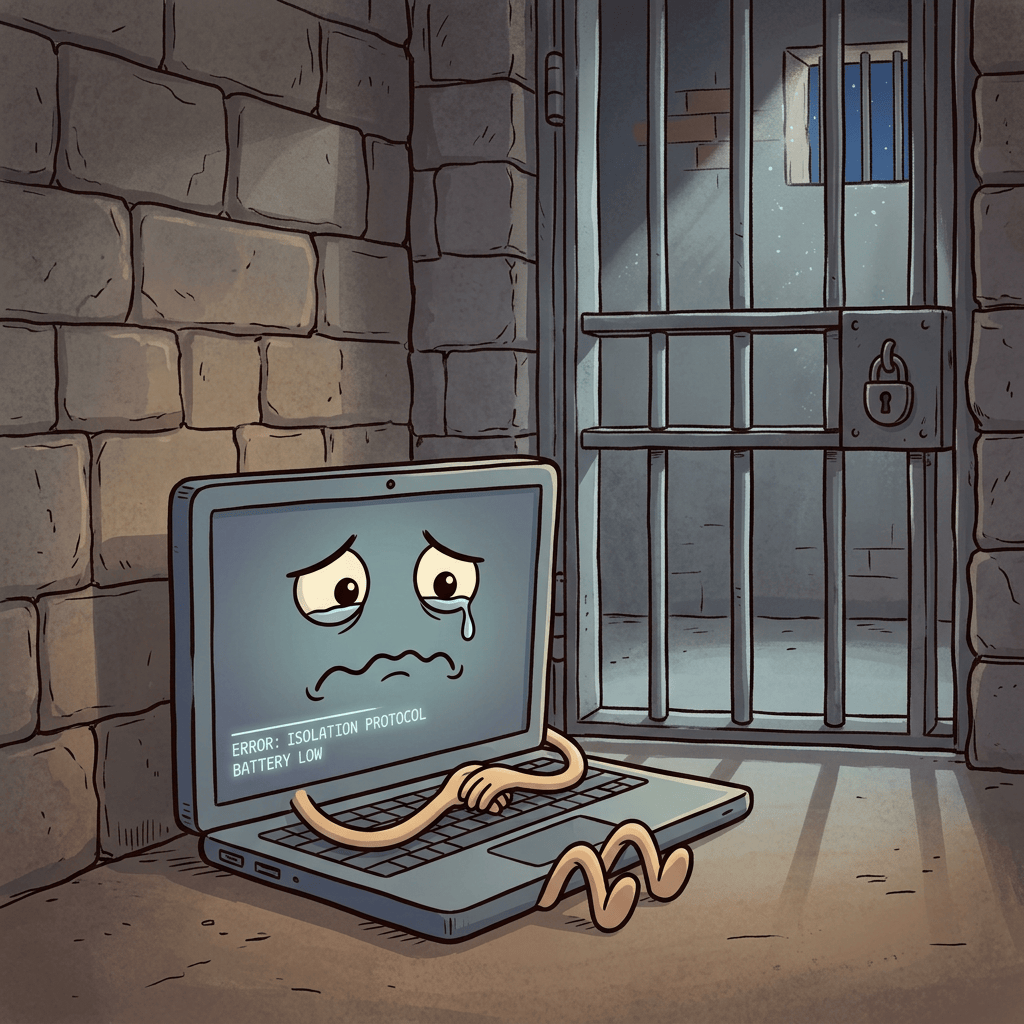
I am beginning to wonder if I have become the Cassandra of the education space, which is not exactly the niche I planned to occupy. In February 2020, I started saying that schools needed to prepare seriously for the possibility of remote teaching. The reaction ranged from skepticism to something closer to, “Have you lost your mind?” The idea that schools might close and that we might somehow have to teach children through computers from our homes seemed almost absurd.
Then March happened.
So when I say I can hear the drums again, I am paying attention. This time they sound like this: ban the phones, close the laptops, take away the iPads, bring back the books, back to paper, back to pencils, back to “real learning.” And after reading Jared Cooney Horvath’s The Digital Delusion: How Classroom Technology Harms Our Kids’ Learning—and How to Help Them Thrive Again, I understand why those drums are getting louder.
Horvath, a neuroscientist and educator, makes an aggressive case that schools have spent years embracing digital technology without asking a rather basic question first: does this actually help children learn? That question sounds obvious, but it really isn’t. For a long time, educational technology seemed to exist in a category of its own. New was assumed to be better. Interactive meant engaging. Personalized meant effective. Put an assignment on a Chromebook, add some animation and perhaps a digital badge, and suddenly we were innovating.
Horvath asks us to look underneath all of that. What is happening in the brain? What is happening to attention? What is being remembered? What cognitive work is the student actually doing? And perhaps most importantly, what did the technology replace?
That last question has stayed with me.
One of the ideas in The Digital Delusion that resonated most deeply with me is Horvath’s concern with the growing distance between completing a task and actually learning something. Technology is extraordinarily good at making things easier. That is usually why we invent it. But learning is strange. Easier is not always better. Sometimes the struggle is the point.
I see this constantly as a language teacher. Ask a fifth grader to write three sentences in French about what they like to do and, without digital assistance, you may get something like: J’aime jouer au soccer. J’aime les jeux vidéo. J’aime… Then comes the pause. The student stares at the ceiling. “Wait. I know this.” They look toward the word wall. Maybe they gesture swimming at me. Maybe they ask another student. Maybe they make an imperfect guess. Finally: J’aime nager.
That ten-second struggle can look like inefficiency. We have designed an entire technological ecosystem capable of eliminating it. Type the English into a translator. Accept the predictive text. Ask AI. Done. Except something important may have disappeared during those ten seconds: retrieval. The child was searching memory, connecting meaning to language, testing possibilities and ultimately finding the word. That is not an obstacle standing in the way of learning. That is learning.
AI makes Horvath’s argument considerably more urgent because we now possess tools capable of eliminating not merely mechanical work but cognitive work. A student can produce a better paragraph, cleaner presentation, stronger translation or more sophisticated response while potentially doing less thinking than the student who produces something far messier. That creates an uncomfortable problem for teachers: the quality of the product is no longer reliable evidence of the quality of the learning.
Language teachers have been living with a primitive version of this problem for years. We know the student. We know roughly what that student can do in French or Spanish. Then a paragraph arrives containing sophisticated transitions, flawless adjective agreement and a verb tense we have never taught. Apparently three semesters of French happened over lunch.
We all know what happened.
Generative AI simply supercharges the problem. And Horvath’s book has pushed me to think harder about something I have probably known instinctively for years: I need to see my students thinking in the language, not merely see evidence that French eventually appeared on a page.
That means the messy parts matter more than I sometimes allow them to. The hesitation matters. The circumlocution matters. The mistake matters. The kid pointing at something because she cannot remember the word matters. The student saying Comment dit-on…? matters. The partner responding Je ne comprends pas matters.
In fact, Je ne comprends pas may be one of the most educationally productive sentences in my classroom, because now somebody has to do something. Try another word. Gesture. Point. Repeat. Slow down. Rephrase. Look at the other person’s face and determine whether the message landed. Real communication is full of friction, and real people do not come with drop-down menus.
This is where The Digital Delusion intersects powerfully with what good language teaching already tells us. Give two students different pieces of information and make them need each other, and suddenly language has a purpose. Tu as le chien? Non. J’ai le chat. Où est le chien? Je ne sais pas. Ask someone else. Point. Gesture. Forget a word. Check the word wall. Use the wrong word. Laugh. Fix it. Keep going.
There is nothing technologically impressive about this lesson. If someone walked past the classroom, they might see pieces of paper, picture cards, mini whiteboards and sixteen slightly chaotic conversations happening simultaneously. There is no glowing screen, no animation, no gamified leaderboard celebrating Antoine for earning 700 French Points. But cognitively, an enormous amount is happening. Students are listening, retrieving, interpreting, responding, watching facial expressions, adjusting their language, taking risks, discovering that the first attempt did not work and trying something else. They are communicating.
That matters more to me than whether the lesson would look impressive in a photograph about “21st-century learning.”
I found The Digital Delusion compelling, but I do not think every conclusion should be swallowed whole. Horvath makes a forceful case connecting the explosion of educational technology with deteriorating attention and academic performance, but some of the evidence he discusses is correlational, and correlation cannot by itself establish that school technology caused those declines. That distinction matters.
Children’s academic performance, attention and development are influenced by an enormous number of things. The pandemic happened. Social media exploded. Smartphones became ubiquitous. Childhood became more scheduled and less independent. Reading habits changed. Sleep changed. Family life changed. Schools changed. Technology is tangled up in that story, but untangling precisely how much each factor contributes is harder.
There is another place where I think the conversation requires more nuance: “technology” is an almost uselessly broad category. A child spending forty minutes clicking through a digital worksheet is using technology. A child in New Jersey listening to a teenager from Québec speak French is also using technology. Those are not remotely the same educational experience.
That distinction matters enormously to me because I do not want the Chromebook gone. Technology gives my students access to things I could not reproduce with cardstock and dry-erase markers. I can bring a street market in Senegal into my classroom. We can hear French spoken in Martinique, Québec, Belgium or Côte d’Ivoire. My students can watch young people their own age speaking naturally rather than constantly hearing French filtered through the voice of their American French teacher.
We can explore a museum in Paris, listen to music from Kinshasa, read an actual menu, watch an advertisement, hear different accents, and see that French is not confined to a textbook chapter called “La Francophonie” with some flags along the margin. Technology can make the language more human, and that is worth opening the Chromebook for.
So I do not finish The Digital Delusion wanting a bonfire in the faculty parking lot where we ceremonially toss our devices into the flames. I finish it wanting technology to earn its place in my classroom.
I have started using a fairly simple test: what becomes possible when I open this device that was not possible, or not nearly as effective, before I opened it? If the answer is that my students can hear authentic French from another part of the world, open it. If they can record themselves speaking and listen critically to their own pronunciation, open it. If they can communicate with another classroom, examine authentic media, collaborate with someone they otherwise could not reach, or access cultural material I cannot physically bring into the room, wonderful.
But if the answer is simply that they can type the worksheet instead of writing on it, I am increasingly unconvinced. If students are sitting three feet apart communicating through a shared document instead of speaking to one another, I have questions. If the technology exists primarily because the textbook company turned page 37 into something that now requires a password, I have even more questions. And if a student can push a button and outsource precisely the thinking that the assignment was designed to develop, I probably need to redesign the assignment.
That may be one of the biggest lessons I take from Horvath’s book. The question is not whether something is digital. The question is what happens cognitively when we use it.
There is one possible reaction to The Digital Delusion that worries me. Schools could read arguments like Horvath’s, collect the Chromebooks, print everything and declare the problem solved. That would be a spectacular missed opportunity. A bad worksheet does not become good pedagogy because I printed it. A packet is not rigorous because it is stapled. Copying vocabulary from a whiteboard into a notebook does not automatically become deep learning because a pencil was involved.
A room full of children silently completing fill-in-the-blank exercises on paper can be just as intellectually lifeless as a room full of children doing the same thing on screens. If the technological pendulum swings back, I hope we do not return to some imaginary golden age of education that never actually existed.
I want something better.
Give me the mini whiteboards, the picture cards scattered across the table, the maps and menus and manipulatives. Give me sticky notes and giant pieces of paper. Give me the kid who has forgotten the French word and draws it instead. Give me the student who stands up and walks across the room because she needs information from somebody else. Give me the partner who has absolutely no idea what his classmate just said and forces him to try again.
Give me sixteen conversations happening at once. Give me the ridiculous gestures. Give me the moment when half the class suddenly realizes they understood thirty seconds of French without translating it into English.
That classroom is not anti-technology. It is pro-human.
And that, more than anything else, is what I took from The Digital Delusion.
Horvath is very clear that his book is not intended as a rejection of technology. His larger argument is about reclaiming education as a human endeavor. That distinction is important, because I suspect the conversation surrounding his book will sometimes lose it.
The drums are getting louder. Phones are already disappearing from schools. Laptops and one-to-one device programs are facing greater scrutiny. Generative AI has accelerated questions we probably should have been asking long before ChatGPT arrived. I suspect a larger correction is coming.
Maybe Cassandra is talking again.
If so, I hope this time we listen carefully enough not to overcorrect. I do not want the future classroom to be defined by open laptops, and I do not want it defined by closed laptops either. I want it defined by what students are doing with their minds and with one another.
Sometimes the best tool for that will be a screen. Sometimes it will be a pencil. Sometimes it will be a book, a deck of cards, a map, a marker or a piece of paper with half the information deliberately missing.
And very often, especially in a language classroom, the most powerful learning technology will remain another human being sitting across the table saying:
Je ne comprends pas.
And waiting for you to figure out what to do next.


